The Ranchers Multiplayer & Co-op Guide: Hosting, Roles, and Shared-Ranch Discipline
Answer first
Update every player to 0.8.10.842 or later, sign into Steam, and choose one deliberate session owner before spending shared resources. Once everyone is inside the same ranch, split work by complete domains—fields, livestock, building, or purchasing—instead of duplicating the same chore.

Hosting & joining: setup walkthrough
The Ranchers supports 1–4 player online co-op. The official launch notes confirm multiplayer-ready quests, while the July 30 hotfix addresses a join failure affecting some friend sessions.
Before anyone hosts
- Update together. Confirm every player is on 0.8.10.842 or later before diagnosing invitations.
- Sign into Steam. Offline solo works, but co-op and other online features require an active Steam connection.
- Pick a session owner deliberately. Save ownership and transfer behavior should be tested in your build before the group commits to a long shared world.
- Decide the ranch's identity first. Crop-focused? Animal-heavy? A builder's paradise? Five minutes of alignment before the world is created saves a week of pulling in different directions.
Hosting the session
- Create or load the intended world and open its multiplayer session.
- Invite Steam friends only after every client reports the same build.
- Confirm all players enter the same ranch before spending shared resources or advancing quests.
- Run one save-and-rejoin test early to learn how the current build preserves guest and world progress.
Do not publish assumptions about save ownership, guest inventory, or wallet sharing as facts. Test each behavior in the current build and keep the session owner consistent until the result is clear.
Role splits for 1–4 players
The number one co-op failure mode in farming games isn't conflict — it's duplication: two players watering the same field while the animals go unfed. The fix is zones of ownership. Each player owns a domain end-to-end; within an in-game week, nobody touches someone else's domain without asking.
Solo (1 player)
Everything is yours, so sequencing replaces splitting: crops in the morning, town and selling midday, planning and light chores in the evening. Our beginner's guide roadmap is built exactly for this.
Duo (2 players)
- Player 1 — Fields: tilling, planting, watering, harvesting, seed purchasing. Owns the crop calendar.
- Player 2 — Everything else: animals, selling runs, shopping, quests, building. Effectively the ranch's operations manager.
Trio (3 players)
- Fields lead: the entire crop pipeline.
- Barn lead: all livestock — feeding, collecting, care, housing repairs, feed stockpiling.
- Road lead: selling, buying, quests, fishing and other active work for filler income, scouting prices.
Full crew (4 players)
- Fields lead: crops, sized to the crew's combined watering capacity (which is much larger — scale up boldly).
- Barn lead: livestock end-to-end. Owns the feed budget.
- Builder: construction, upgrades, layout, storage logistics. The force multiplier — a well-placed building saves the whole crew time every day.
- Quartermaster: sells everything, tracks prices, keeps the crew's money records, pre-buys next season's seeds, and approves all large purchases. The least glamorous and most important role.
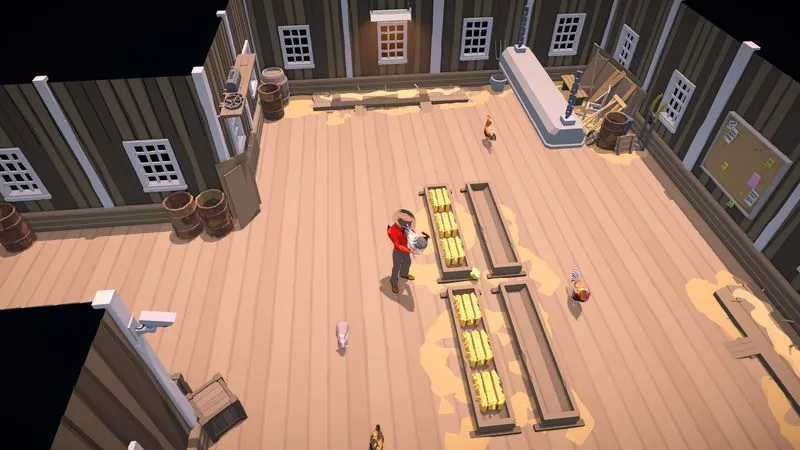
Rotate roles between in-game weeks if anyone gets restless — but within a week, stable ownership beats flexibility every time.
Daily timetables for every crew size
A shared day structure prevents the two classic co-op leaks: morning chaos (everyone asks "what should I do?") and evening waste (everyone logs off with energy unspent). Here's the 4-player template; smaller crews simply merge columns:
| Time of day | Fields | Barn | Builder | Quartermaster |
|---|---|---|---|---|
| Morning | Water & harvest everything | Feed & collect products | Continue current project | Check prices; plan the sales route |
| Midday | Replant; till new plots | Animal care; repair housing | Gather building materials | Selling run to town; request board |
| Evening | Everyone converges on tomorrow's bottleneck — usually unwatered fields, an unfinished building, or an unstocked feed store | |||
The evening convergence is the highest-leverage habit in co-op play. A short coordinated wrap-up at day's end routinely prevents an entire in-game day of stalled progress.
Shared-resource rules that prevent co-op chaos
- One wallet, one spender. Whether all sales revenue lands in one shared wallet still needs verification in the current build — test it early in your session. Either way, only the quartermaster makes purchases above an agreed threshold. Duplicate machine purchases are the classic co-op money bonfire.
- Chests have purposes, not owners. Label storage by function — seeds, harvest-to-sell, building materials, animal feed — and everyone returns items to their labeled home. Twenty seconds of discipline, zero lost items.
- Never harvest someone else's ready crop without a word — not out of greed, but because the fields lead may be timing a sale or a quest turn-in.
- Feed stock is sacred. The barn lead sets a minimum feed reserve; dipping below it is a crew-level emergency announced immediately.
- Plan seasons together. Before day one of each season, the crew agrees the crop plan using the crop database and profit calculator. Unguided individual planting is how you end up with four seasons of the wrong crop.
- Log off deliberately. End sessions with tomorrow's plan stated out loud: what's planted, what needs water, what's being built, what's being sold.
Troubleshooting: lag, saves, permissions
Use this order before changing saves, reinstalling, or abandoning a world:
- Version: every player must update to 0.8.10.842 or later.
- Steam status: every player must be signed in and online; Offline Mode supports solo, not co-op.
- Invitation: close the failed invitation, reopen the session, and send a fresh Steam friend invite.
- World check: confirm the intended ranch was loaded before deciding progress is missing.
- Bug report: capture the build, session size, host steps, guest steps, and error screen for the official Steam Bug Reports forum.
Known launch issue status
The official hotfix says a problem preventing players from joining a friend's session in certain situations has been fixed. That does not prove every connection problem is gone, so version and reproduction details still matter.
Co-op FAQ
How many players does The Ranchers support?
1–4 players online, including the host, on one shared ranch. Solo play is fully supported — co-op is a multiplier, not a requirement.
Who should host our co-op world?
Choose one consistent session owner while your group tests save and guest-progress behavior. The official launch notes do not document save transfer, so do not assume the world is portable.
Do joining players keep their own ranch?
The official material reviewed here does not define guest inventory or ranch-import behavior. Test with a short session and rejoin before committing a long-running group save.
How do we split work between 4 players?
Zones of ownership: a fields lead, a barn lead, a builder, and a quartermaster who tracks the crew's spending (whether the wallet is literally shared is still unverified in the current build). See the timetables above — and converge everyone on tomorrow's bottleneck each evening.
Is there crossplay between PC and console?
Steam lists Cross-Platform Multiplayer, but the current supported-platform combinations and account flow should be checked in the live build before planning a mixed-platform group.
What's the biggest co-op mistake to avoid?
Duplicated spending and duplicated chores. One quartermaster approves big purchases, and every domain has exactly one owner per in-game week.
What happens to the farm if I end up in jail?
Official According to the official Police District update notes, while you are in custody your friends can join your game in multiplayer, visit you, and take care of your crops and cattle — so a jail sentence does not have to mean a dead ranch.
Related guides
- Beginner's Guide — the solo fundamentals co-op builds on.
- Money-Making Guide — how co-op changes the ranch economy.
- Crop Database — plan the crew's season together.
- Profit Calculator — agree on money-makers with shared numbers.
Official sources
- Official Steam news — launch hotfix 0.8.10.455 and multiplayer-ready quest notes.
- Official Steam store page — 1–4 player online co-op and platform features.